
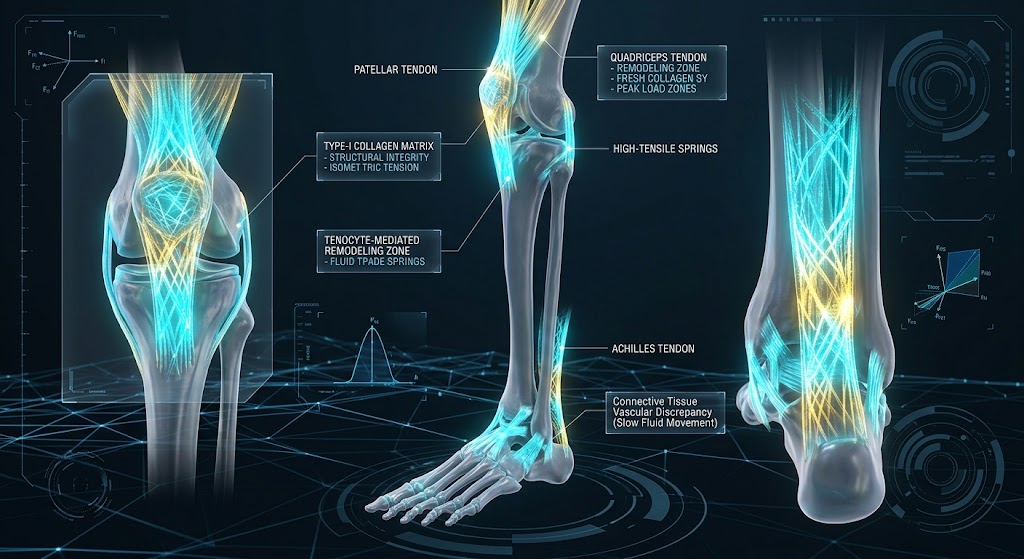
If you've ever had tendonitis, knee tracking pain, or forearm strain after back-to-back big air sessions, you've experienced the vascular discrepancy: muscle tissue adapts to physical stress far faster than connective tissue. While muscles enjoy rich blood flow and repair rapidly, tendons and ligaments rely on slow fluid movement to receive nutrients. Understanding this lag is the secret to building a frame that withstands decades of hard riding.
1. The Collagen Matrix & Structural Stiffening
Tendons act as high-tensile springs that store and release mechanical energy every time you load up an edge or absorb a landing. They are primarily composed of Type-I collagen fibers bound in a crystalline matrix:
- The Adaptational Lag: Muscles remodel in roughly 2 to 3 weeks following heavy stress. Tendons require 2 to 3 months for meaningful structural turnover.
- Overuse vs. Load Stimulus: Without targeted loading, collagen matrices become disorganized, leading to micro-tears, chronic inflammation, and tendinopathy.
- Cross-Linking Mechanics: High-load training stimulates tenocytes (tendon cells) to produce fresh collagen, increasing tendon cross-sectional area and stiffness—the good kind of stiffness that protects joints from hyper-extension.
The Gold Standard Tendon Rules
To trigger collagen synthesis without irritating joint cartilage, remember two principles: Isometrics for Pain Relief (holding high tension without movement) and Slow Tempo for Remodeling (taking 3 to 4 seconds on both the lowering and lifting phases). Fast, bouncy movements train muscle power, but slow, heavy tempos rebuild tendons.
2. The Practical Tendon Bulletproofing Routine
Incorporate these four specific protocols into your off-water training twice a week to shield your knees, ankles, and forearms from high-wind loads:
1. Spanish Squat Holds (Patellar Tendon Armor)
Loop a thick resistance band around a secure post and step both legs inside, placing the band directly behind your knees. Step back until there is heavy tension, then sink down into a 90-degree squat position while keeping your shin bones strictly vertical.
Why it works: Holding this isometric position drives intense fluid exchange in the patellar tendon, immediately lowering knee pain while reinforcing tendon stiffness for hard landings.
2. Heavy Slow Single-Leg Calf Raises (Achilles & Ankle Density)
Stand on the edge of a step on one foot, holding a dumbbell in one hand for balance. Take a full 4 seconds to lower your heel below the step, pause for 1 second at the bottom stretch, and take 4 seconds to press up onto your toes.
Why it works: The slow, controlled tempo forces the Achilles tendon to undergo heavy mechanical strain, stimulating tenocytes to lay down fresh, parallel collagen fibers.
3. Tibialis Wall Raises (Ankle & Shin Shock Absorption)
Lean your upper back flat against a wall with your feet placed about two feet out in front of you. Flex your ankles to pull your toes up toward your shins as high as possible, hold for 2 seconds, and slowly lower back down.
Why it works: Strengthens the anterior tibialis muscle and tendon, creating a front-line brake system that stops your ankles from collapsing during heavy flat landings.
4. Eccentric Wrist Extensions & Pronation (Bar Grip & Elbow Shield)
Rest your forearm on a table holding a light dumbbell with your palm facing down. Use your opposite hand to help lift the weight up, then slowly lower the dumbbell down toward the floor using only the target arm over a strict 4-second count.
Why it works: Directly targets the extensor tendons of the forearm, preventing golfer's and tennis elbow caused by holding down a powered bar in gusty winds.
3. Hydration & Intercellular Fluid Flow
Because tendons are avascular (lacking direct blood vessels), nutrient transport relies on "fluid squeezing." When a tendon is loaded, water is forced out of the extracellular matrix; when released, fresh fluid carrying amino acids is drawn back in like a sponge.
To maximize this mechanism, ensure you are deeply hydrated with trace minerals before entering the water, and engage in light, full-range movement on off days to keep fluid moving through dense joint capsules.
4. The Deliberate Remodeling Phase
Riding hard three days in a row creates a cumulative deficit in collagen synthesis. Inserting a dedicated recovery day featuring gentle mobility, passive hanging, and heavy isometric holds gives tenocytes the quiet window they need to lay down new collagen fibers. Respect the tissue lag, build structural armor, and your joints will stay rock-solid for life.
Fuel Your Collagen Matrix (10% Off)
To accelerate connective tissue remodeling and supply your tenocytes with the exact amino acids needed to rebuild, stack your load protocols with pure collagen peptides. Use discount code KITEHOMIEZ at checkout for 10% off your entire order.
Shop DoNotAge Collagen Peptides →