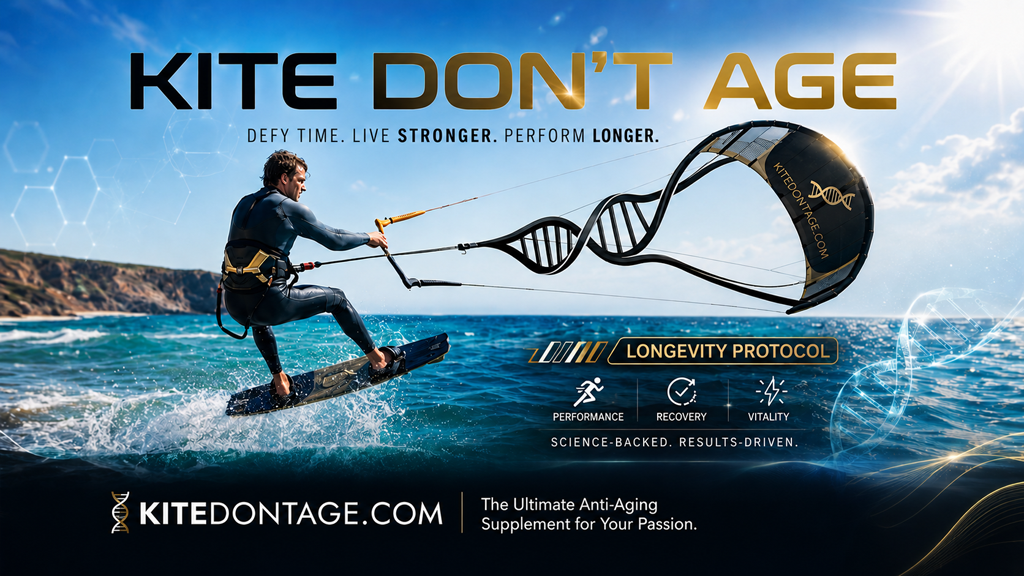
Kite Don't Age

The Ultimate High-Performance Longevity & Recovery Protocol Engineered for Kiteboarders.

Get Your Daily Sachet The Playbook Free Routine

Use code KITEHOMIEZ for 10% off your DoNotAge order

The Cellular Foundation

Training, sleep and smart riding do most of the work. These are the supplements we take every single day to cover the rest, so we can ride hard, recover fast and keep doing it for decades.

Step 2: Add What You Need

Code KITEHOMIEZ = 10% Off Everything

Want to go further? These are the add-ons we recommend most to kiters, and why:
Build Your Stack
Kite Don't Age Graphic Timeline

The Forever Rider Playbook

The routines we actually use to keep riding hard in our 40s, written for any kiter. Short, practical, and each one links to the deep dive if you want the science.

Body: Train, Fuel, Recover

01 / Core & Strength +

The kite pulls your hips forward and tries to arch your lower back all session long. A core that resists that pull means a pain-free back, and strong legs mean knees that survive landings. About 15 minutes, 3 to 4 times a week.

Why it matters for kitersMost kiting aches come from load your body isn't ready for: an arched back under harness pull, knees caving on landings, ribs taking a crash. Every exercise below targets one of those.
ExerciseDoseKey cue
Front Plank3 x 30-60 sPull ribs toward hips, tailbone slightly tucked. No sagging.
Side Plank2 x 30 s / sideStraight line head to feet. Builds the side wall that resists kite pull.
Dead Bug2 x 10 / sideLower back stays glued to the floor. Shorten the reach if it lifts.
Bird Dog2 x 8 / sideHold 5 s, hips level, leg no higher than hip height.
Glute Bridge2 x 15 (or 10 single-leg)Drive through heels, finish with the glutes, not the lower back.
Wall Sit + Block Squeeze2 x 45 sSqueeze a yoga block between the knees for knee tracking.
Pull-ups or Rows3 sets, 2 short of failureLats and grip for bar control and unhooked riding.
Push-ups2-3 setsBalanced, stable shoulders for crashes and water restarts.
Desk day? Exercise snacks. Every 1 to 2 hours: 10 thoracic rotations per side, a 30-second wall sit with the block, and a 30 to 60-second hang from a bar. Two minutes, and your back will thank you on the next windy day.
  • After a big wind day: halve the planks and dead bugs, keep the bridges, rotations and hangs.
  • Knee pinch after heavy landings? Skip deep squats for 48 hours and stick to wall sits.

Deep dives: Defending the Lumbar Spine · The Anti-Fragile Kiter · The 100-Year Frame · Shoulders, Elbows & Wrists · Bones That Survive the Crashes · VO2 Max

02 / Stretching & Mobility +

Tight hips and backs after riding are mostly your nervous system guarding the joints, not short muscles. Forcing a deep stretch makes it guard harder. The fix is a sequence: calm it, center the joint, open it up, then lock the range in with strength.

The breathing ruleDuring every hold, breathe in through your nose for 4 seconds and out slowly for 8. Long exhales switch your body toward rest-and-repair mode, and that's when tight muscles let go.

1. Reset (2 min)

  • Block squeeze & rock: on all fours, a yoga block between the knees, squeeze gently and rock your hips back and forth. 2 x 45 s.
  • Windshield wipers: sitting, knees bent, feet wide, let both knees fall side to side. 20 reps.

2. Warm Up the Hips (3 min)

  • Fire hydrant circles: on all fours, 5 slow circles per side, each direction. Keep the back still.
  • Cossack squats: wide stance, shift side to side into a deep lateral squat. 10 total.
  • Cobra: 10 gentle press-ups from your stomach to reverse the hunched riding posture.

3. Deep Stretch (5-10 min, when warm)

  • Frog, butterfly, pancake straddle and pigeon: 1 to 3 minutes each. Ease in, never force it. Each exhale, let yourself sink a little deeper.

4. The "Save Button" (2 min)

  • Adductor flies: lie on your back, legs up, slowly lower them wide, pause, then squeeze them back together. 2 x 15-25. Strength at the end of your range is what keeps the flexibility from disappearing overnight.
Just landed the kite? 5-minute version. Hang from a bar 30-60 s, 90/90 hip switches x 8, half-kneeling hip flexor stretch 30 s per side, block squeeze & rock 45 s. Do it while your kite dries.

Deep dive: The Neurological Hip Lock

03 / Food & Fasting +

No extreme diets. Real food, enough protein, a daily eating window, and the occasional longer fast when the wind is off.

The Plate

  • Mostly whole food: cut ultra-processed snacks and sugary drinks first. That one change does the most.
  • Protein at every meal: roughly 1.6 g per kg of body weight per day for active people. Fish, eggs, meat, Greek yogurt, beans and lentils.
  • Olive oil as your main fat: extra virgin, rich in polyphenols, the backbone of the Mediterranean diet.
  • Smart carbs around riding: sweet potato, rice, oats, fruit. Fuel the session, skip the sugar spikes.
  • Longevity foods every week: oily fish (sardines, mackerel, salmon), mushrooms, berries, walnuts, leafy greens, and a little fermented food daily.
  • Hydrate: water plus electrolytes on hot, windy days. You lose more than you think.

The Clock

  • Daily eating window: 14 to 16 hours overnight without food (water, black coffee and tea are fine). Move it so you still eat 1 to 3 hours before a big session.
  • Kitchen closes 3 hours before bed: better sleep, better overnight recovery.
  • Occasional longer fast: on a no-wind day, healthy and experienced fasters can go 24 hours, some of us up to 40, with plenty of water and electrolytes. Skip it if you're pregnant, underweight, diabetic or new to fasting.

Deep dives: The Autophagy Shield · Glycation Protection · Gut Health & the Traveling Kiter · Heat, Hydration & Cramps · NMN & NAD+

04 / Sleep & Recovery +

Sleep is when your body actually repairs the damage from the session. It's the most powerful recovery tool you have, and it's free.

Evening Routine

  • Same times every day: aim for 7 to 9 hours with a consistent bedtime and wake-up, even on trips.
  • Dim the lights after sunset: blue-blocking glasses in the evening and screens off an hour before bed protect your natural melatonin.
  • Cool, dark room: your core temperature has to drop for deep sleep.
  • Go easy on alcohol: it fragments sleep and raises your overnight heart rate. Skip it before big wind days.
  • Wind down: 5 minutes of gentle stretching with 4:8 breathing.
  • Calming helpers: magnesium glycinate or glycine before bed, and a chamomile and lemon balm tea.
Let your watch decide. If your HRV is well below normal or your resting heart rate is up in the morning, make it a light day: mobility, a walk, an easy session. Push hard when the numbers say you've recovered.

Deep dives: Sleep: The Recovery Tool · Coming Back From Injury · SIRT6 & DNA Repair · Reversing the Biological Clock

Mind & Water: Ride Smart

01 / Before You Launch +

Most serious kiting injuries happen on land, during launching and landing, or from gear failure. Five minutes of prep removes most of that risk.

Gear & Safety Check

  • Lines, pigtails and bridles: look for wear and knots before every session.
  • Quick release: actually test it on the beach regularly. Sand and salt jam them.
  • Assisted launches and landings: clear space downwind, a helper who knows what they're doing, and clear signals.

Read the Day

  • If in doubt, size down: being overpowered is the fastest way to hurt your back and knees.
  • Trim, don't muscle: when the wind picks up, use the depower so you can stay upright and relaxed.
  • Watch for gusts and lulls: look upwind for dark patches on the water and plan your jumps for the steady wind.
  • The 80% rule: do your hardest tricks in the first part of the session. Tired reflexes cause the worst crashes.

Body Armor

  • Harness fit: snug and low enough that it doesn't ride up into your ribs, with the bar within easy reach.
  • Impact vest and helmet for big-air or crowded days.
  • Sun protection: long-sleeve top, SPF 50, zinc on the face, UV400 sunglasses.

Deep dives: Harness Setup · Sun, Salt & Glare · Cold-Water Kiting · Heat & Hydration

02 / The Mental Game: Fear, Focus & Flow +

A tense mind makes a stiff body, and a stiff body crashes harder. The riders who progress fastest aren't fearless. They know how to calm down, commit, and keep it fun.

Before a Big Trick

  • One long exhale: try a "physiological sigh" (two short inhales through the nose, one long exhale through the mouth). It's one of the fastest ways to bring your heart rate and nerves down.
  • See it first: on the beach, close your eyes and run the trick in your head, step by step: edge, kite position, pop, release, landing. Sports research shows mental rehearsal really does improve motor skills.
  • One trigger word: pick one cue for the moment of commitment ("edge", "patience", "look"). One thought, not ten.

Working With Fear

  • Small steps: go one step outside your comfort zone, not three. Lower jumps, less wind, more reps.
  • Fear is information: if it's screaming, something is off: too much wind, too tired, not ready yet. Listen to it, then build up.
  • Celebrate the crashes: every wipeout means you're learning at the edge. Laugh it off and go again.
The sofa standard. Every session, even a bad one, is infinitely better than a session spent on the sofa. Ride for the joy, and the progress follows.

Deep dive: The Mental Game: Fear, Focus & Flow

03 / Progression, Crew & Gratitude +

Riding for decades is a long game. The right goals, the right people and the right attitude keep you improving and keep you loving it.

Progress on Purpose

  • Write your next 2 or 3 tricks down: break each one into parts (edge, kite position, pop, rotation, landing) and work on one part per session.
  • Film yourself: a few phone clips per session show you more than a hundred attempts.
  • Get coaching: a few lessons fix bad habits fast and save you from the crashes that come from guessing.

Your Crew

  • Ride with stoked people: energy is contagious. People who laugh off mistakes keep you loose.
  • Find riders slightly better than you: close enough to learn from, far enough to push you.

Gratitude

  • Write down 3 good things a day: studies on gratitude journaling link it to better mood and well-being. It also gets you through injuries and windless weeks.
  • Enjoy the tricks you already have: don't let the next one steal the fun from this one.
  • Separate who you are from what you land: your worth isn't your trick list. That's how you stay stoked for 30 more years.

Deep dive: Your Crew Is a Longevity Tool

Free. You'll confirm by email (double opt-in). We'll also send our new videos and posts every few weeks. Unsubscribe anytime.

Latest From the Water

The protocols on this site, tested in real wind. Our newest Kitehomiez episode:

Who Won Squamish's Big Air Kite Comp? North West Wind Open 2026

Subscribe to Kitehomiez on YouTube →

Latest Longevity Insights

Deep-dive weekly breakdowns on the engineering, biology, and tactical strategy behind staying on the water forever.

Week 24 // Sun

Chasing the Sun in Winter: Vitamin D for Kiters in the Dark Months

Why northern kiters get so little sun from October to March, five ways to get more light, and the D3 + K2 we take all winter.

Read Blueprint →
Week 23 // Training

Winter Dryland for Kiters: Stay Kite-Fit When There's No Wind

A 3-day home plan for balance, landings, harness core and grip, plus how to keep your kite skills sharp until spring.

Read Blueprint →
Week 22 // Recovery

Recovery After a Big Kite Weekend: How to Keep Sending for Decades

The 48-hour plan after a comp or storm session, using the off-season to build the next one, and what we take every day.

Read Blueprint →
View All Blueprints & Articles →